Pregnant male seahorses support growing babies by forming placenta (2024)

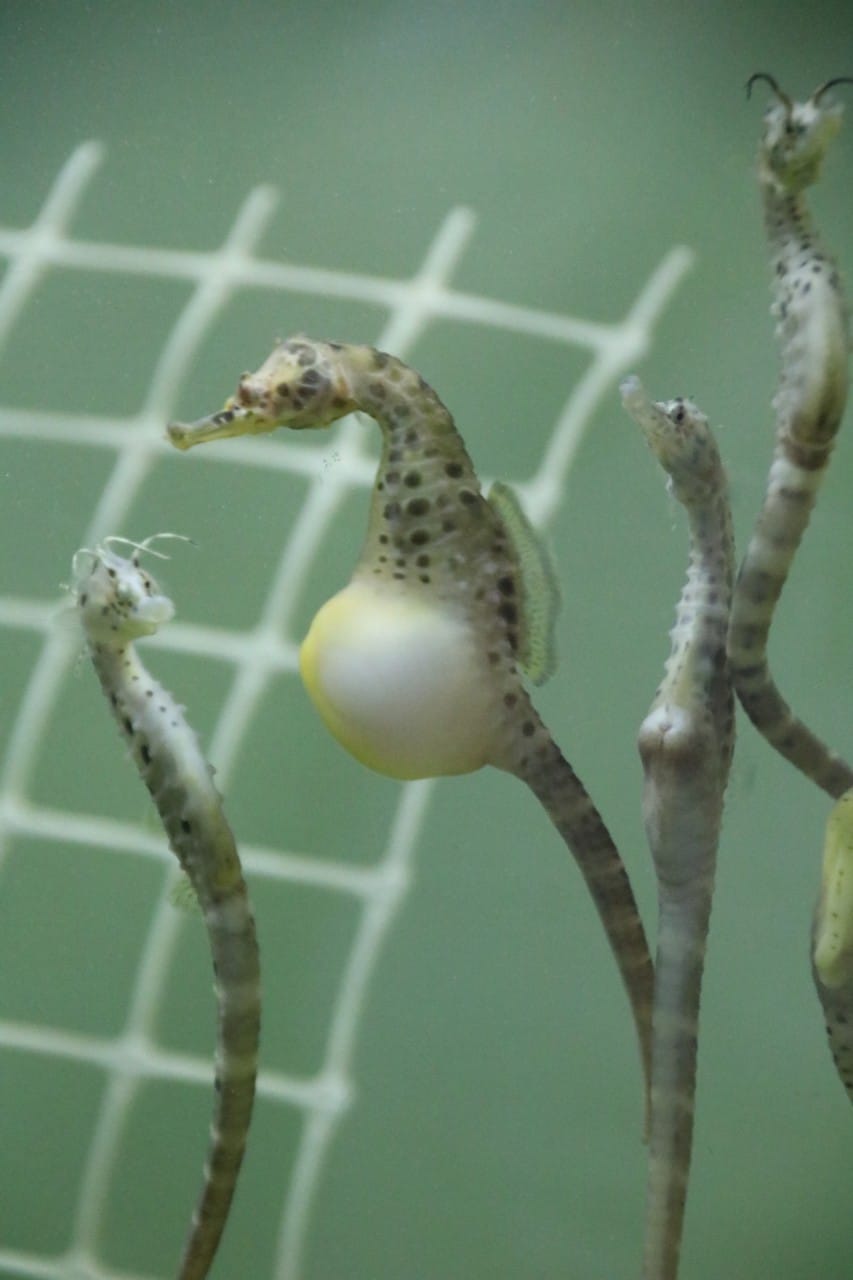
Male seahorses incubate their embryos inside a pouch and, until now, it was unclear how embryos breathed inside this closed structure. A new study examines how pregnant male seahorses provide oxygen to, and remove carbon dioxide from, their embryos.
Pregnant male seahorses support growing babies by forming placenta (1)

Supplying oxygen to their growing offspring and removing carbon dioxide is a major challenge for every pregnant animal. Humans deal with this problem by developing a placenta, but in seahorses — where the male, not the female, gestates and gives birth to the young — exactly how it worked hasn’t always been so clear.

Male seahorses incubate their embryos inside a pouch, and until now it was unclear how the embryos “breathe” inside this closed structure. Our new study, published in the journalPlacenta, examines how pregnant male seahorses (Hippocampus abdominalis) provide oxygen supply and carbon dioxide removal to their embryos.

We examined male seahorse pouches under the microscope at different stages of pregnancy, and found they develop complex placental structures over time — in similar ways to human pregnancy.

A pregnant dad gestating up to 1,000 babies

Male pregnancy is rare, only occurring in a group of fish that includes seahorses, seadragons, pipehorses and pipefishes.

Pot-bellied seahorse males have a specialised enclosed structure on their tail. This organ is called the brood pouch, in which theembryos develop.

The female deposits eggs into the male’s pouch after amating danceand pregnancy lasts about30 days.

While inside the pouch, the malesupplies nutrientsto his developing embryos, beforegiving birthto up to 1,000 babies.

Embryonic development requires oxygen, and the oxygen demand increases as the embryo grows. So too does the need to get rid of the resulting carbon dioxide efficiently. This presents a problem for the pregnant male seahorse.

Enter the placenta

In egg-laying animals — such as birds,monotremes, certain reptiles and fishes — the growing embryo accesses oxygen and gets rid of carbon dioxide through pores in the egg shell.

For animals that give birth to live young, a different solution is required. Pregnant humans develop a placenta, a complex organ connecting the mother to her developing baby, which allows an efficient exchange of oxygen and carbon dioxide (it also gets nutrients to the baby, and removes waste, via the bloodstream).

Placentae are filled with many small blood vessels and often there is a thinning of the tissue layers that separate the parent’s and baby’s blood circulations. This improves the efficiency of oxygen and nutrient delivery to the fetus.

Surprisingly, the placenta is not unique to mammals.

Some sharks, like the Australian sharpnose shark (Rhizoprionodon taylori)develop a placentawith an umbilical cord joining the mother to her babies during pregnancy. Manylive-bearing lizards form a placenta(including very complexones) to provide respiratory gases and some nutrients to their developing embryos.

Our previousresearchidentified genes that allow the seahorse father to provide for the developing embryos while inside his pouch.

Our newstudyshows that during pregnancy the pouch undergoes many changes similar to those seen in mammalian pregnancy. We focused on examining the brood pouch of male seahorses during pregnancy to determine exactly how they provide oxygen to their developing embryos.

What we found

By viewing the seahorse pouch under the microscope at various stages of pregnancy, we found that small blood vessels grow within the pouch, particularly towards the end of pregnancy. This is when the baby seahorses (called fry) require the most oxygen.

The distance between the father’s blood supply and the embryos also decreases dramatically as the pregnancy goes on. These changes improve the efficiency of transport between the father and the embryos.

Interestingly, many of the changes that occur in the seahorse pouch during pregnancy are similar to those that occur in the uterus during mammalian pregnancy.

We have only scratched the surface of understanding the function of the seahorse placenta during pregnancy.

There is still much to learn about how these fathers protect and nourish their babies during pregnancy — but our work shows the morphological changes to seahorse brood pouches have a lot in common with the development of mammalian placentae.

This article was first published on The Conversation and written by Dr Camilla Whittington from University of Sydney and Dr Jessica Suzanne Dudley from Macquarie University.

Pregnant male seahorses support growing babies by forming placenta (2024)

FAQs

Do male seahorses have a placenta? ›

Male seahorses develop complex placental structures in their brood pouches, which allow for the efficient exchange of oxygen and carbon dioxide with the embryos during pregnancy.

How is the male pregnancy and the formation of seahorse species? ›

Reproduction in seahorses is even more unusual as the male, rather than the female, becomes pregnant. Recent research on seahorse mating behaviour reveals that male pregnancy in seahorses and their relatives has had profound effects on the evolutionary legacy of these organisms.

How do seahorse babies grow? ›

In seahorses and pipefish, it is the male that gets pregnant and gives birth. Seahorse fathers incubate their developing embryos in a pouch located on their tail. The pouch is the equivalent of the uterus of female mammals. It contains a placenta, supporting the growth and development of baby seahorses.

Can seahorses change gender? ›

Seahorses are not one of those animals who change their sex. The female lays the eggs and the male carries the fertilized eggs on his back. They remain male and female.

When a male seahorse gets pregnant doesn't that make him a female? ›

The female seahorse produces the eggs . Only females in any group of organisms produce eggs. She places the fertilized eggs into the male seahorses egg pouch and he carries them until they hatch and beyond. Just because the eggs hatch and are cared for by him don't make him a female..

What is the only male animal known to man that gives birth? ›

Seahorses and their close relatives, sea dragons, are the only species in which the male gets pregnant and gives birth. Male seahorses and sea dragons get pregnant and bear young—a unique adaptation in the animal kingdom. Seahorses are members of the pipefish family.

Do seahorses feel pain when giving birth? ›

They experience definite labor pains when birth is imminent, evident as a series of powerful contractions, and soon begin pumping in time with these birth spasms in order to forcibly eject the fry from their pouches. Labor usually begins well after dark in the early morning hours or shortly after dawn (Vincent, 1990).

Do seahorses mate for life? ›

Most wild seahorses (here the thorny seahorse Hippocampus histrix ) are monogamous and some species mate for life. Searching for mates can be difficult and risky since seahorses are poor swimmers, found in low densities and rely on camouflage to hide from predators.

What are 5 facts about seahorses? ›

Diving into the whimsical world of Seahorses: 10 fun facts!
  • Male Seahorses carry the baby during reproduction. ...
  • Seahorses are monogamous. ...
  • Seahorses are terrible swimmers. ...
  • They eat by suction. ...
  • Seahorses don't have stomachs. ...
  • There are over 40 different species of Seahorses. ...
  • Their tails have a useful tool.
More items...
Feb 10, 2026

Are seahorses asexual? ›

Expert-Verified Answer. Sea horses reproduce sexually.

Why do male seahorses give birth? ›

Why do male sea horses become pregnant? By passing the eggs to her mate, the female can invest her energies in producing more eggs immediately after transferring the previous batch – so almost as soon as the male gives birth he becomes pregnant again.

How does a man give birth? ›

People who are born male and living as men cannot get pregnant. A transgender man or nonbinary person may be able to, however. It is only possible for a person to be pregnant if they have a uterus. The uterus is the womb, which is where the fetus develops.

What animal has the most babies at once? ›

Common tenrecs have loads of babies

Firstly, they produce the most offspring of any mammal, having up to 30 babies at a time. Secondly, they have the most nipples of any species of mammal - a staggering 36 of them!

Who carries baby seahorses mom or dad? ›

Male Seahorses Get Pregnant and Give Birth

After the male and female seahorses spend time courting, the female deposits her eggs inside the male's pouch. The male then fertilizes the eggs inside the pouch. Instead of growing their babies inside a uterus like human moms do, seahorse dads carry their babies in a pouch.

Top Articles
Pokemon Hitomi La
George The Animal Steele Gif
Halsted Bus Tracker
This TikTok Mother / Daughter Duo Have Dark Conspiracy
The Omega Man - Internet Movie Firearms Database
Jackson County Jail, IN Inmate Search: Roster & Mugshots
Az Unblocked Games
Bryyf Stocktwits
2005 Ford Super Duty F-350 SRW diesel for sale - East Windsor, CT - craigslist
Ufc 281 Tapology
Latest Posts
Article information

Author: Geoffrey Lueilwitz

Last Updated:

Views: 5475

Rating: 5 / 5 (60 voted)

Reviews: 91% of readers found this page helpful

Author information

Name: Geoffrey Lueilwitz

Birthday: 2026-03-23

Address: 74183 Thomas Course, Port Micheal, OK 55446-1529

Phone: +13408645881558

Job: Global Representative

Hobby: Sailing, Vehicle restoration, Rowing, Ghost hunting, Scrapbooking, Rugby, Board sports

Introduction: My name is Geoffrey Lueilwitz, I am a zealous, encouraging, sparkling, enchanting, graceful, faithful, nice person who loves writing and wants to share my knowledge and understanding with you.